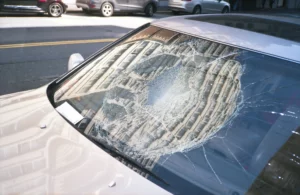
After a serious crash, your insurance company may decide that your vehicle is a total loss. That usually means the cost to repair the vehicle is too high compared with what the car was worth before the accident.
Once that happens, the insurance company does not usually pay what you originally paid for the car. It also may not pay what you still owe on your loan. Instead, the insurer usually looks at the vehicle’s actual cash value, often called ACV.
Actual cash value is one of the most important parts of a total loss claim. It can affect whether your insurance check is enough to replace your vehicle, pay off your loan, cover related expenses, or leave you with a financial gap.
If your car was totaled and you are unsure whether the insurance company’s offer is fair, you can request a free case evaluation to better understand your next step.
What Is Actual Cash Value in Car Insurance?
Actual cash value is the estimated value of your vehicle immediately before the accident happened. It is not the original purchase price. It is not always the dealership price. It is not automatically the amount left on your loan.
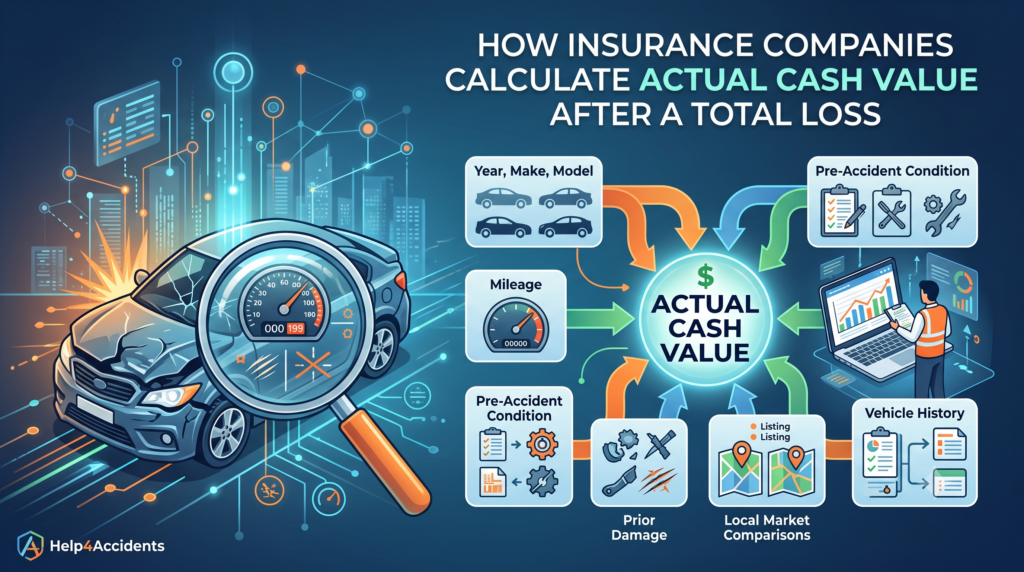
Instead, ACV usually reflects what your vehicle was worth in the market before the crash, after accounting for factors such as age, mileage, condition, trim level, options, accident history, and local comparable vehicle prices.
For example, two vehicles with the same year, make, and model may not have the same actual cash value. A lower-mileage vehicle in excellent condition may be worth more than a similar vehicle with high mileage, prior damage, missing features, or poor maintenance history.
Why Actual Cash Value Matters After a Total Loss
The insurance company’s ACV number often becomes the starting point for your total loss settlement. If the insurer values your vehicle too low, your settlement check may not be enough to replace the car with a similar vehicle.
This can create serious frustration. You may believe your vehicle was worth more because you maintained it well, recently added tires, completed repairs, or still owe money on the loan. The insurance company may rely on valuation reports, comparable sales, and internal formulas that do not always reflect your situation accurately.
Actual cash value matters because it affects your practical recovery after the crash. A low ACV offer can leave you without reliable transportation, struggling with a loan balance, or forced to accept a replacement vehicle that is not similar to the one you lost.
If you are dealing with a broader accident settlement, review car accident settlement amounts for additional factors that may affect your claim.
How Insurance Companies Calculate Actual Cash Value
Insurance companies usually calculate actual cash value by reviewing vehicle details and market data. They may look at your car’s year, make, model, trim, mileage, options, condition, location, and pre-accident value.
They may also compare your vehicle with similar vehicles for sale or recently sold in your area. These are often called comparable vehicles or “comps.” The insurer may then adjust the value up or down based on differences between your vehicle and the comparable vehicles.
Common valuation factors include:
- mileage
- vehicle age
- trim package
- optional features
- pre-accident condition
- prior damage
- accident history
- maintenance records
- local market prices
- title status
- recent repairs
- aftermarket upgrades
- supply and demand for that vehicle type
The problem is that valuation reports can contain mistakes. A report may list the wrong trim level, miss options, use poor comparable vehicles, undervalue condition, ignore recent repairs, or rely on vehicles that are not truly similar.
Actual Cash Value vs. Replacement Cost
Actual cash value and replacement cost are not the same.
Replacement cost usually means what it would cost to replace an item with a similar one. Actual cash value usually accounts for depreciation and market value at the time of loss.
In a total loss vehicle claim, the insurance company often focuses on what your car was worth immediately before the accident, not the cost of buying a newer or better vehicle. This is why many accident victims feel the offer is too low even when the insurance company says it followed its valuation process.
The key question is whether the insurer’s ACV number fairly reflects the vehicle you actually had before the crash.
What If the Insurance Offer Is Too Low?
You do not have to automatically accept the first actual cash value offer. If the number seems too low, ask for the valuation report and review it carefully.
Check whether the report has the correct year, make, model, trim, mileage, options, package, condition, and location. Look at the comparable vehicles used. Are they actually similar? Are they in your market? Do they have similar mileage and features? Are they available at the listed price?
You can also gather your own evidence. Search for similar vehicles for sale nearby. Save listings that match your vehicle’s year, make, model, trim, mileage, condition, and features. Provide receipts for recent major repairs, new tires, maintenance, upgraded parts, or improvements that may support a higher value.
If the insurance company’s offer still seems unfair, you may be able to dispute the valuation.
For related guidance, review what happens if the insurance check does not cover the full repair cost.
Can You Negotiate Actual Cash Value?
Yes, you may be able to challenge or negotiate the actual cash value if you have evidence that the insurer’s valuation is too low.
The strongest disputes usually include specific documentation, not just disagreement. Helpful support may include comparable vehicle listings, maintenance records, repair receipts, photos showing pre-accident condition, dealership estimates, private-party listings, valuation reports, and evidence that the insurer used incorrect information.
When responding to the insurer, be organized. Point out specific errors. Provide better comparable vehicles. Explain why the selected vehicles are not similar. Show proof of recent repairs or upgrades. Ask for a revised offer in writing.
Avoid accepting the payment as final until you understand whether signing documents will release your claim. Some checks or forms may affect your ability to dispute the total loss amount later.
What If You Still Owe Money on the Car Loan?
One of the hardest total-loss situations happens when the ACV settlement is less than the remaining loan balance. This can happen if the vehicle depreciated quickly, the loan had high interest, the down payment was low, or negative equity was rolled into the loan.
In that situation, the insurance company may pay the actual cash value, but you may still owe the lender. This is where gap insurance can matter.
For this exact situation, keep and internally link to what happens if you still owe a car loan after a total loss and what gap insurance covers after a car accident.
What Happens If Your Car Is Declared a Total Loss?
If your car is declared a total loss, the insurance company usually reviews the damage, calculates the vehicle’s actual cash value, subtracts any applicable deductible, and issues a settlement based on the policy and claim facts.
You may need to sign title documents, release the vehicle, remove personal belongings, return rental vehicles, or work with your lender if there is a loan. If you want to keep the vehicle, the insurer may apply a salvage value deduction, depending on the policy and state rules.
Because the process can involve several moving parts, keep what happens if your car is declared a total loss after an accident as a supporting article and link it from this page.
Can Loss of Use or Rental Coverage Help?
Actual cash value only addresses the value of the totaled vehicle. It may not automatically solve the transportation problem created by the crash.
Depending on the policy and fault situation, rental reimbursement, loss of use, or other coverage may help while the claim is pending. This can matter if you need transportation for work, medical appointments, childcare, or daily responsibilities.
For related support pages, link to rental reimbursement coverage after a car accident and loss of use after a crash.
Actual Cash Value and Injury Claims Are Separate Issues
A total loss property damage claim is not the same as an injury claim. Your vehicle’s actual cash value deals with the value of the car. Your injury claim may involve medical bills, lost wages, pain and suffering, future treatment, and other injury-related damages.
Do not assume that resolving the vehicle claim automatically resolves the injury claim. Also be careful with settlement documents. Make sure you understand whether a release applies only to property damage or whether it could affect injury claims too.
For the broader injury claim process, review personal injury claim after an accident.
Common Mistakes to Avoid in an ACV Dispute
Do not accept the first offer without reviewing the valuation report. Do not assume the insurance company correctly listed your vehicle. Do not ignore mileage, trim, features, condition, or recent repairs. Do not rely only on emotional value or what you originally paid.
Also avoid signing documents you do not understand. A total loss release, property damage release, or settlement form may affect your rights. If the paperwork is unclear, ask questions before signing.
Save every document connected to the claim, including the estimate, valuation report, comparable vehicles, emails, letters, repair receipts, loan documents, title paperwork, and payment details.
When to Request a Free Case Evaluation
You should consider a free case evaluation if your vehicle was totaled, the ACV offer seems too low, you still owe money on the loan, the insurer used poor comparable vehicles, the claim involves injuries, the other driver was uninsured, or the insurance company is pressuring you to settle quickly.
You may also want help if you are unsure whether a release affects only property damage or also your injury claim.
Start here: Get a Free Case Evaluation.
Conclusion
Actual cash value is one of the most important parts of a total loss car insurance claim. It determines what the insurance company believes your vehicle was worth immediately before the crash.
If the offer seems too low, review the valuation report, check the vehicle details, compare similar listings, gather repair and maintenance records, and ask for a written explanation. A low actual cash value offer can affect your ability to replace your vehicle, pay off a loan, and move forward after the crash.
If you were injured or are unsure whether the insurance company’s offer is fair, request a free case evaluation to better understand your next step.
FAQ Section
What does actual cash value mean in car insurance?
Actual cash value is the estimated market value of your vehicle immediately before the accident. It usually accounts for age, mileage, condition, trim, features, depreciation, and local comparable vehicle prices.
How do insurance companies calculate actual cash value?
Insurance companies usually review the vehicle’s year, make, model, mileage, trim, options, condition, prior damage, local market data, and comparable vehicle listings or sales.
Can I dispute the insurance company’s actual cash value offer?
Yes. You may be able to dispute the offer by reviewing the valuation report, pointing out errors, providing comparable vehicle listings, and submitting repair receipts, maintenance records, or other proof that supports a higher value.
Does actual cash value include what I still owe on my loan?
Not necessarily. Actual cash value is based on the vehicle’s value before the accident, not the remaining loan balance. If you owe more than the ACV offer, gap insurance may help depending on your coverage.
Is actual cash value the same as replacement cost?
No. Replacement cost usually refers to what it would cost to replace something with a similar item. Actual cash value usually reflects market value after depreciation and other valuation factors.
What should I do if my car is declared a total loss?
Ask for the valuation report, review the vehicle details, compare similar vehicle listings, save all paperwork, remove personal belongings from the vehicle, confirm whether a loan is involved, and avoid signing anything you do not understand.
👉 Get your free case evaluation today:
https://help4accidents.com/get-a-free-case-evaluation-page/