An ambulance ride can produce a bill before the insurance claim is anywhere close to resolved. That timing often causes confusion: the ambulance provider may bill the injured person directly while auto insurers, health insurers, and other parties are still deciding who is responsible.
There is no single payer in every car accident. Depending on the state, the policies involved, fault, and the person’s health coverage, the bill may be handled by personal injury protection, medical payments coverage, health insurance, Medicare or Medicaid coordination rules, the at-fault party’s liability insurer, or some combination of those sources. If coverage is delayed or denied, the patient may remain responsible to the provider while the dispute is addressed.
This guide explains the common payment paths and the practical steps to take when an ambulance bill arrives. It is general information, not legal advice. Coverage rules and claim procedures vary, so review the actual policies and obtain advice for the state where the crash occurred.
The Short Answer: The Bill May Move Through More Than One Payer
The ambulance company usually creates an account in the patient’s name because the patient received the service. That does not necessarily mean the patient will ultimately bear the full cost.
Possible payment sources include:
- no-fault or personal injury protection coverage;
- medical payments coverage on an auto policy;
- the injured person’s health insurance;
- Medicare or Medicaid, subject to coordination and recovery rules;
- workers’ compensation if the crash happened in the course of work;
- the at-fault driver’s bodily injury liability coverage; and
- the patient’s own payment while reimbursement or a liability claim is pending.
Which path applies depends on the policies and law involved. The first step is not to assume the bill is wrong or that another driver will pay it immediately. The first step is to verify the charge and route it to the correct coverage.
Common Ways an Ambulance Bill Is Paid
Personal Injury Protection or no-fault benefits
In states with personal injury protection, often called PIP, certain accident-related medical expenses may be paid without waiting for a fault decision, subject to the policy and state rules. Ambulance transportation may fall within covered medical expenses when the service is accident-related and otherwise eligible.
PIP limits, deductibles, priority rules, and required forms vary. A bill can also arrive after available benefits have already been used for emergency care or other treatment. Confirm the remaining benefit amount rather than assuming the policy will cover every medical charge.
Medical payments coverage
Medical payments coverage, commonly called MedPay, may pay eligible medical expenses for the insured person and covered passengers regardless of fault. Whether it applies, the available limit, and the documentation required depend on the policy.
If you have this coverage, notify the carrier promptly and ask whether the ambulance provider should submit the bill directly. Help4Accidents has a separate explanation of how MedPay works after a car accident.
Health insurance
Health insurance may process an ambulance claim, but deductibles, coinsurance, network rules, medical-necessity standards, and coordination requirements can affect the amount paid. An insurer may request accident information because another policy could be primary.
Give the ambulance provider accurate health-insurance information, but also tell the health plan that the care followed a motor-vehicle accident. Hiding the accident can create payment and recovery problems later.
Medicare
Medicare Part B generally covers ground ambulance transportation when travel in another vehicle could endanger the person’s health and transportation is needed to an appropriate facility, subject to Medicare’s coverage rules. Medicare explains that it may cover transport only to the nearest appropriate medical facility able to provide the needed care.
When no-fault or liability insurance is involved, Medicare may be a secondary payer. The Centers for Medicare & Medicaid Services explains that no-fault or liability coverage may pay first for accident-related health services. In some situations Medicare may make a conditional payment and later seek recovery after a settlement, judgment, award, or other payment.
For current federal details, review the official Medicare ambulance-services coverage page and CMS guidance on liability and no-fault coordination.
The at-fault driver’s liability insurer
If another driver is legally responsible, the ambulance charge may be part of a bodily injury claim. But liability coverage often does not pay each medical provider immediately. The claim may need investigation, proof of fault, medical records, and a broader evaluation before payment or settlement.
That delay is why an injured person should not ignore a bill while waiting for the liability claim. Contact the provider, identify available first-party or health coverage, and keep documentation showing how the charge was handled.
Workers’ compensation
If the collision occurred while the person was performing job duties, workers’ compensation may be relevant. Reporting rules and authorized-provider procedures vary by state. Report the incident to the employer promptly and ask the appropriate carrier or administrator how medical transportation should be billed.
Ambulance Bill Payment Paths
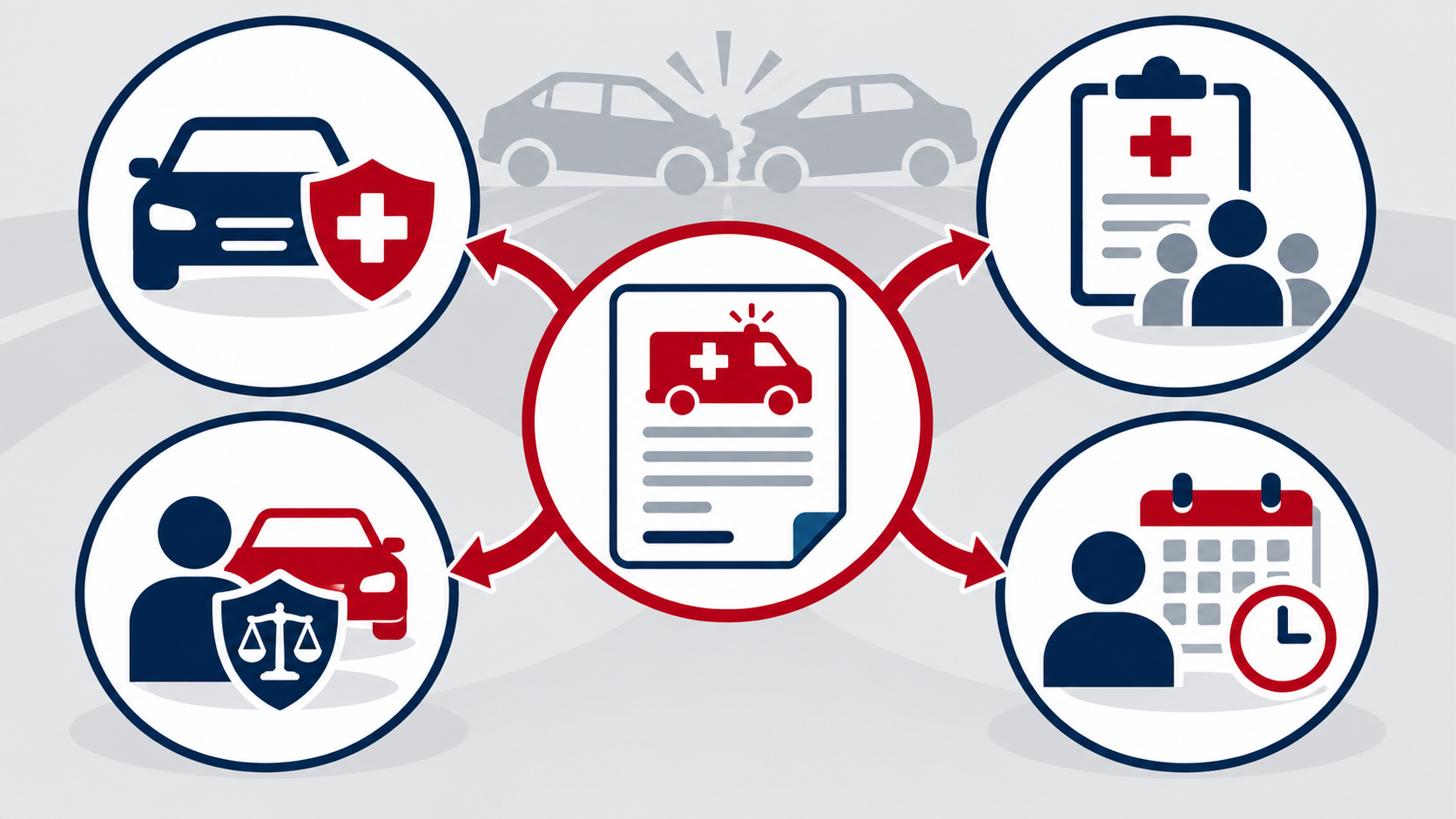
When a bill arrives, think of it as a routing problem. The bill may begin with the patient but move through one or more coverage sources before the final balance is known.
The practical sequence often looks like this:
- Verify that the bill matches the date and service.
- Ask the ambulance provider what insurance information it has.
- Notify applicable auto and health insurers.
- Obtain claim numbers and submission instructions.
- Track payments, adjustments, denials, and remaining balances.
- Preserve the final bill and explanation of benefits for the accident claim.
Do not pay a confusing balance simply to make the paperwork disappear, but do not ignore it either. A timely phone call can reveal that the provider lacks a policy number, claim number, or accident date.
What to Check When the Bill Arrives
Confirm the patient, date, and transport
Make sure the bill belongs to you and reflects the correct date, pickup point, destination, and type of service. If something is wrong, request a corrected itemized bill.
Ask whether insurance was billed
The provider may have outdated or incomplete insurance information. Ask which payer was billed, when the claim was submitted, and whether the provider received a rejection or request for more information.
Compare the bill with the explanation of benefits
An explanation of benefits is not a bill. It shows how an insurer processed a claim, what was allowed, what was paid, and what it says the patient may owe. Compare those figures with the provider’s statement and ask about any mismatch.
Look for a denial reason
A denial can result from missing claim data, coordination questions, coverage limitations, or a medical-necessity determination. The reason matters because different problems require different responses. Request the denial in writing and note any appeal deadline shown by the insurer. Do not rely on a generic deadline from an online article; use the notice and policy that apply to your claim.
Preserve every version
Keep the original bill, corrected bills, insurer notices, payment receipts, and call notes. Medical bills can change after adjustments or coordination between payers. A complete file makes it easier to show the actual amount paid or still owed.
What If You Cannot Pay the Bill Right Away?
Contact the ambulance provider rather than waiting for repeated notices. Explain that the charge is connected to an auto accident and that insurance coordination is in progress. Ask about:
- placing the account on a temporary hold;
- resubmitting the claim with corrected information;
- a reasonable payment plan;
- financial-assistance screening, if available;
- an itemized bill; and
- the process for disputing an error.
Do not promise a payment you cannot make. Document the date, representative, and exact arrangement. If the account has already been sent to collections, ask both the provider and collector for written account information and dispute inaccuracies in writing.
Can the Ambulance Bill Be Included in an Injury Claim?
An ambulance charge may be part of claimed accident-related medical expenses when the service is connected to the crash and legally recoverable. That does not mean every charge is automatically accepted or paid in full. Insurers may examine causation, medical necessity, documentation, policy limits, and the law that applies.
Keep evidence that connects the bill to the collision:
- crash report or incident information;
- ambulance run report, if available;
- emergency-department records;
- the itemized ambulance bill;
- insurer explanations of benefits;
- proof of payments; and
- correspondence about denials or adjustments.
These records can also support a well-documented car accident demand letter when a liability claim is appropriate.
Do Not Sign Away the Injury Claim by Mistake
Property-damage paperwork and bodily-injury releases are not always the same. Before signing a release, understand which claims and expenses it covers. A broad release may affect unresolved medical expenses, depending on its language and applicable law.
If the ambulance bill or other treatment costs remain unsettled, consider obtaining legal advice before agreeing to a final injury settlement. A consultation can clarify how medical balances, insurer reimbursement claims, and settlement funds interact in the relevant state.
Questions to Ask the Ambulance Provider
Use a short checklist during the call:
- Do you have my correct auto and health insurance information?
- Which insurer did you bill first?
- What response did you receive?
- Can you provide an itemized statement?
- Is the account on hold while insurance reviews the claim?
- What is the process for correcting or disputing the bill?
- Are payment plans or assistance programs available?
- Has the account been transferred to another billing company or collector?
Write down the answers. If another company handles billing, confirm its name and contact information through the provider rather than relying on an unexpected text or email.
Build a Complete Medical-Bill File
The ambulance bill is usually only one part of the financial picture after a crash. Emergency care, imaging, physicians, follow-up visits, medication, therapy, and other services may be billed separately.
Create one file with a running list of providers, dates, billed amounts, insurer responses, payments, and unresolved balances. If you have already received several statements, the guide to negotiating medical bills after an accident explains how to review the broader set of charges.
Also keep the evidence described in Help4Accidents’ step-by-step guide to what to do after a car accident. Billing questions become easier to resolve when the underlying accident and treatment records are organized.
Get Help Before a Billing Problem Becomes a Claim Problem
An ambulance bill after a car accident may be paid through auto medical coverage, health insurance, a government benefit program, a liability claim, or multiple coordinated sources. The correct route depends on the actual policies and law involved.
Verify the bill, notify the right insurers, preserve every explanation and payment record, and communicate with the provider while the claim is pending. If the crash caused significant injury, coverage is disputed, or a settlement is being discussed while medical bills remain open, consider speaking with a qualified attorney in the relevant jurisdiction.