
An insurance company may ask you to sign a medical records authorization after a car accident. The form can look routine, especially when it arrives with other claim paperwork. But signing it may give another party permission to request protected health information from listed providers or other record holders.
That does not mean every request is improper or that every person should refuse. The right response depends on the exact form, who is requesting it, which claim is involved, your insurance policy, and the law of the applicable state. Before signing, understand what the document authorizes and whether its scope matches the reason records are needed.
This article provides general educational information, not legal advice. It does not tell every reader to sign or reject a form.
What Is a Medical Records Authorization?
A medical records authorization is a written document that permits specified health information to be used or disclosed. Under federal HIPAA rules, a valid authorization generally identifies the information covered, who may disclose it, who may receive it, and when the authorization expires. It also addresses the individual’s right to revoke the authorization in writing, subject to limits explained in the form.
The authorization is different from your own request to inspect or obtain copies of your health records. The U.S. Department of Health and Human Services explains that individuals generally have a right to access protected health information in designated record sets maintained by covered providers and health plans. That right can be useful when you want to review your own records for accuracy or provide selected documents yourself.
Why Might an Insurer Request Medical Records?
Medical information can be relevant to an injury claim. An insurer may seek records to evaluate:
- whether the reported injury is documented;
- when symptoms and treatment began;
- what care was provided;
- whether treatment is related to the crash;
- the amount and nature of medical expenses; or
- whether another health condition may affect the claim.
Some access to relevant records may be necessary to evaluate benefits or damages. The important question is not simply whether records matter. It is what the form allows the requester to obtain, from whom, for what period, and for what purpose.
Medical records are one part of a broader documentation picture. Our guide to evidence that helps a car accident claim explains how medical documentation fits alongside photographs, reports, witness information, and other records.
Your Own Insurer and the Other Driver’s Insurer Are Not the Same
People sometimes receive requests from their own insurance carrier and from an insurer representing another driver. Those relationships can involve different policy terms, duties, interests, and state-law rules.
Do not assume that a form is harmless because it came from “the insurance company.” Identify the company, claim number, person requesting it, and the legal or contractual basis stated for the request. If it comes from your own carrier, review the relevant policy language rather than guessing about your obligations. If it comes from another party’s carrier, understand that the company is evaluating a claim against its insured.
The same care applies when an insurer requests a statement. Before agreeing, review our guide to a recorded statement after a car accident.
What to Check Before Signing
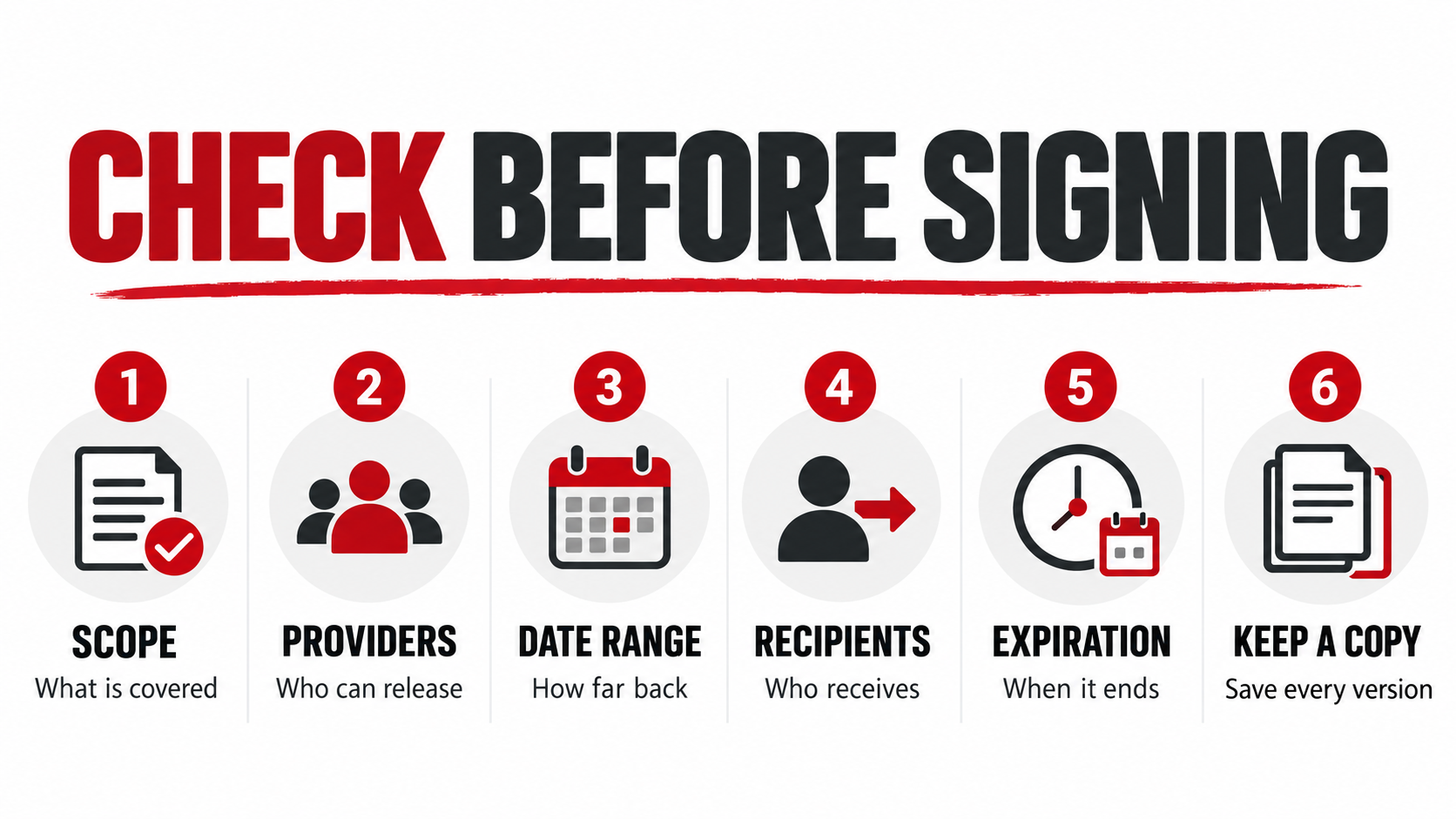
Read the full authorization, including attachments and fine print. Do not sign a document with material blank spaces.
1. The information covered
Look for the description of records the form permits the recipient to obtain. Does it request treatment and billing records related to the crash, or does it use broad language covering an entire medical history? Does it include imaging, pharmacy records, mental-health information, substance-use records, genetic information, or other sensitive categories?
Different categories can be subject to additional federal or state protections. The scope should be reviewed in the context of the claim and applicable law.
2. The providers or organizations
Check who is authorized to disclose information. A form might name a treating provider, list several facilities, or use language covering broad classes of providers. Confirm that the names and descriptions are accurate.
3. The date range
Look for the beginning and ending dates. A request may seek records from the date of the crash forward, a period before the crash, or a much broader history. Earlier records may sometimes be relevant—for example, when the claim involves an alleged aggravation of a preexisting condition—but relevance depends on the facts.
4. The recipients
Identify each person or organization allowed to receive the records. Check whether the form permits redisclosure and explains that information disclosed to some recipients may no longer be protected by HIPAA in the same way.
5. The purpose
The form may state that records will be used to evaluate or administer an insurance claim. Confirm that the stated purpose matches the request you received.
6. Expiration
HHS guidance explains that a HIPAA authorization must contain an expiration date or an expiration event related to the individual or the purpose of the disclosure. State law can impose more restrictive requirements. Review how long the form remains effective and whether the trigger is clear.
7. Revocation language
The form should explain how to revoke the authorization in writing and any limits on revocation. A revocation generally cannot undo action already taken in reliance on a valid authorization. Keep a copy of any revocation and evidence showing when and where it was delivered.
8. Signature, date, and blank fields
Confirm that the document is complete before signing. Do not leave the type of information, provider, recipient, date range, purpose, or expiration terms open for later completion. Retain an exact copy of the signed form.
Can You Ask for a Narrower Authorization?
Depending on the circumstances, possible approaches may include asking whether the request can be limited to specified providers, relevant categories, or a defined period. Another possible approach is obtaining appropriate records directly and providing copies through an agreed process.
These are not universal solutions. An insurer may have a legitimate basis for requesting additional material, and your policy or state law may affect what cooperation is required. Do not alter a form, withhold records, or ignore a request based only on a general article.
If medical bills are part of the claim, keep complete copies and compare them with explanations of benefits and payment records. The guide to negotiating medical bills after an accident discusses documentation to organize before discussing balances.
Keep a Records Log
Create a simple log showing:
- the date you received the request;
- the requester’s name and contact information;
- the claim number;
- every form signed or declined;
- the records or providers covered;
- when a copy was returned;
- any written questions or proposed limitations; and
- any records you supplied directly.
Save the request, signed form, cover letter, emails, upload confirmations, and delivery receipts. Clear records can reduce confusion if a later disagreement develops about what was authorized or provided.
When Should You Consider State-Specific Legal Guidance?
Consider speaking with a qualified attorney in the relevant state when the authorization is unusually broad, requests sensitive records, reaches far before the collision, contains unclear blanks, or arrives while injury causation or a preexisting condition is disputed. Guidance may also be useful if the insurer threatens a consequence you do not understand or if you are unsure about duties under your own policy.
Deadlines and legal obligations vary. Do not delay a response simply because you are gathering information. Ask what deadline applies, request the basis in writing where appropriate, and seek timely advice about your situation.
For a broader view of the process, read the complete car accident claim guide.
The Bottom Line
Signing a medical records authorization after a car accident is not merely an administrative click. It can define who may obtain health information, what they may receive, and how long the permission lasts.
Read every field. Check the information, providers, dates, recipients, purpose, expiration, revocation terms, and blank spaces. Keep a copy. Then decide based on the actual form, the claim, the policy, and applicable state law—not a blanket rule found online.
If you want help identifying questions to ask about your situation, you can request a free case review. Help4Accidents is not a law firm and does not provide legal advice; claim reviews are performed by a third-party attorney.