Rear-end accidents are often treated like simple cases. Many people assume the driver in the back is always at fault, the insurance company will accept responsibility, and the claim will move forward without much dispute.
That is not always how it works.
In many rear-end accident claims, the rear driver may be presumed responsible because drivers are expected to leave enough space to stop safely. But fault still depends on evidence. A sudden stop, broken brake lights, unsafe lane change, chain-reaction crash, poor road conditions, or a vehicle reversing unexpectedly can all change how liability is evaluated.
If you were injured in a rear-end crash, it is important to understand how fault is determined, what evidence can help your claim, and why you should be careful before accepting a quick insurance settlement. You can also request a free case evaluation if you are unsure what your next step should be.

Why Rear-End Accidents Happen So Often
Rear-end collisions usually happen when one vehicle strikes the back of another. These crashes are common in traffic, at intersections, near stop signs, in construction zones, on highways, and anywhere drivers have to slow down quickly.
Common causes include distracted driving, tailgating, speeding, sudden traffic stops, poor weather, fatigue, impaired driving, and delayed reaction time. A driver who is looking at a phone, following too closely, or moving too fast for traffic conditions may not have enough time to stop.
Even when the crash appears minor, the impact can still cause real injuries. Your body may be thrown forward and backward suddenly, which can strain the neck, back, shoulders, head, and spine. Some symptoms appear immediately, while others may develop hours or days later.
If you are unsure what to do right after a crash, review what to do immediately after a car accident for step-by-step guidance.
Who Is Usually at Fault in a Rear-End Accident?
In many rear-end crashes, the driver who hit the vehicle in front is considered at fault. The basic reason is that drivers are expected to maintain a safe following distance, pay attention to traffic, and adjust their speed for road, weather, and traffic conditions.
If the front vehicle stopped for traffic, a red light, a pedestrian, a hazard, or another normal reason, the rear driver may be responsible for failing to stop in time.
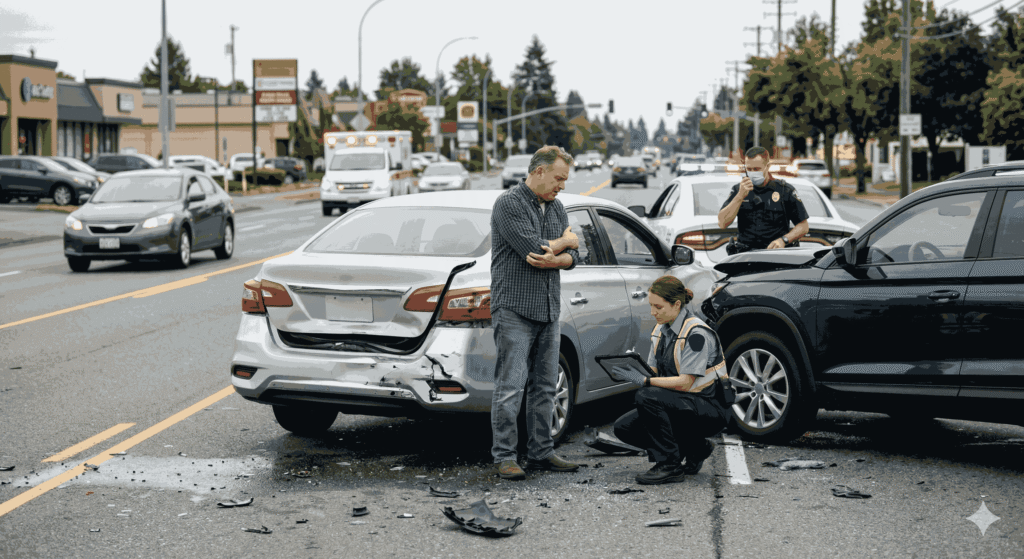
However, fault is not automatic. Insurance companies, attorneys, and claim reviewers look at the facts of the crash. They may consider the vehicle damage, final positions of the vehicles, road conditions, statements from drivers and witnesses, photos, dashcam footage, traffic camera footage, and the police report.
Fault rules can vary depending on the state and accident facts, which is why understanding car accident laws can help after a rear-end collision.
That is why you should not assume the case is settled just because one vehicle hit another from behind.
When Is a Rear-End Collision Not Your Fault?
A rear-end collision may not be entirely your fault if the front driver did something unsafe or unexpected.
One example is sudden and unnecessary braking. If the front driver slammed on the brakes without a valid reason, intentionally brake-checked you, or stopped abruptly in a way that created a hazard, they may share fault.
Another example is broken or non-working brake lights. If the lead vehicle’s brake lights were not functioning, the rear driver may not have had proper warning that the vehicle was slowing or stopping.
Unsafe lane changes can also affect fault. If another driver cuts directly in front of you and brakes suddenly, the crash may be caused by the unsafe merge rather than your driving.
A rear-end crash can also happen when a vehicle reverses or rolls backward. If a front vehicle backs into the car behind it at a stoplight, driveway, parking lot, or traffic lane, the rear driver may not be responsible.
Multi-car crashes are another common exception. In a chain-reaction collision, one vehicle may be pushed into another. Fault may involve several drivers, and the person whose car hit yours may not be the only responsible party. For more on chain-reaction crashes, see multi-car accident liability.
Are Rear-End Accidents Always the Rear Driver’s Fault?
No. Rear-end accidents are not always the rear driver’s fault.
The rear driver is often blamed first, but that is only a starting point. The final decision should depend on evidence. If the front driver acted carelessly, if another vehicle caused a chain reaction, if weather or road hazards played a role, or if the lead vehicle had defective brake lights, fault may be shared or shifted.
This matters because your percentage of fault can affect your claim. If an insurance company says you were partly responsible, it may try to reduce what it pays. If the company says you were mostly or completely responsible, it may deny your claim entirely.
If fault is disputed, do not rely only on what the insurance adjuster says. Gather evidence, keep records, and consider requesting a free case evaluation before agreeing to a fault decision that does not match what happened.
Evidence That Can Help Prove Fault
Evidence is critical in a rear-end accident claim. The stronger your documentation, the harder it is for an insurance company to minimize, deny, or distort the facts.
Helpful evidence may include photos of vehicle damage, photos of skid marks, dashcam video, surveillance footage, traffic camera footage, witness statements, the police report, repair estimates, medical records, and written insurance communications.
Damage patterns can also matter. The location and severity of the impact may help show whether one vehicle stopped suddenly, whether a vehicle was pushed forward, whether the crash involved more than two cars, or whether the collision happened at a higher speed than the other driver claims.
If the police report contains mistakes, missing details, or an incorrect version of events, review the importance of police reports in car accident claims and take steps to document your side clearly.
Common Injuries After a Rear-End Collision
Rear-end crashes often cause injuries that are easy to underestimate at first. Adrenaline may hide pain, and some soft tissue injuries do not fully appear until later.
Common injuries may include whiplash, neck pain, back pain, shoulder injuries, headaches, concussions, herniated discs, numbness, tingling, wrist injuries, knee injuries, and muscle strains.
You should get medical attention if you feel pain, stiffness, dizziness, headaches, numbness, weakness, or symptoms that get worse over time. Delaying treatment can hurt both your recovery and your claim because the insurance company may argue that your injuries were not connected to the crash.
Medical documentation helps connect your injuries to the accident. It can also show the seriousness of your condition, the treatment you need, and how the injury affects your daily life.
What Compensation May Be Available After a Rear-End Accident?
A rear-end accident claim may include compensation for medical expenses, future medical care, physical therapy, diagnostic imaging, pain management, lost wages, reduced earning ability, vehicle repairs, rental car costs, diminished value, pain and suffering, and other accident-related losses.
Medical expenses may include emergency room care, doctor visits, chiropractic treatment, physical therapy, prescriptions, injections, imaging, and follow-up care. If you are unsure who may be responsible for treatment costs, read who pays medical bills after a car accident.
Lost income can also become part of the claim if your injuries force you to miss work, reduce your hours, change duties, or lose future earning ability. For related guidance, see lost wages after an accident.
The value of the claim depends on the facts. A rear-end accident involving temporary soreness will not be valued the same as one involving ongoing treatment, missed work, nerve symptoms, surgery recommendations, or long-term pain.
Why Insurance Companies Dispute Rear-End Accident Claims
Even when fault seems obvious, insurance companies may still push back.
They may argue that the crash was low impact, that your injuries are only soft tissue, that your pain came from a pre-existing condition, that you waited too long to see a doctor, or that you stopped suddenly and caused the crash yourself.
They may also offer a quick settlement before you know the full extent of your injuries. That can be risky because once you accept a settlement, you may not be able to ask for more later if your pain gets worse or your medical bills increase.
Before accepting an early offer, review the hidden dangers of quick insurance settlements.
What to Do After a Rear-End Accident
After a rear-end accident, first check for injuries and call 911 if anyone needs medical help. If it is safe, move out of traffic and wait for assistance.
Take photos and videos of the vehicles, the damage, license plates, road conditions, skid marks, traffic signals, weather, nearby businesses, and the overall crash scene. If there are witnesses, ask for their names and contact information.
Exchange insurance and contact information with the other driver. If police respond, request the report number. If the crash happened near a business or intersection, look for cameras that may have recorded the impact.
Do not admit fault at the scene. Stick to the facts. Avoid guessing about speed, injuries, or who caused the crash. Also be careful when speaking with insurance adjusters. Their questions may be designed to get statements that reduce your claim.
Get medical attention as soon as possible if you have symptoms. Keep all bills, discharge papers, prescriptions, work notes, repair estimates, and insurance letters.
When to Request a Free Case Evaluation
You should consider a free case evaluation if you were injured, if fault is disputed, if the insurance company blames you, if another driver caused a chain reaction, if the other driver is uninsured, if the settlement offer seems too low, or if your injuries are affecting your work and daily life.
You may also want help if the crash involved a truck, commercial vehicle, rideshare vehicle, delivery driver, multiple vehicles, defective brake lights, or a hit-and-run. Rear-end truck accidents can involve different insurance and liability issues, so keep rear-end truck accident claims as a separate supporting article rather than redirecting it into this general page.
Rear-end accident claims may seem simple at first, but disputed fault, delayed injuries, low settlement offers, and insurance tactics can make them stressful quickly.
Conclusion
Rear-end accident claims are not always automatic. The rear driver is often presumed at fault, but evidence determines what really happened. Sudden braking, broken brake lights, unsafe lane changes, reversing vehicles, and multi-car chain reactions can all change how liability is assigned.
The best way to protect your claim is to document the crash, get medical care, preserve evidence, avoid admitting fault, and be cautious with early insurance offers.
If you were injured in a rear-end accident or the insurance company is disputing fault, request a free case evaluation to better understand your next step.
FAQ Section
Are rear-end accidents always the rear driver’s fault?
No. The rear driver is often presumed at fault, but rear-end accidents are not automatic. Fault depends on evidence such as vehicle damage, witness statements, dashcam footage, brake lights, lane changes, sudden stops, and whether another driver caused a chain reaction.
When is a rear-end collision not your fault?
A rear-end collision may not be your fault if the front driver brake-checked you, stopped suddenly without a valid reason, had broken brake lights, reversed unexpectedly, cut into your lane, or if another vehicle pushed your car into the vehicle ahead.
Who is at fault in a multi-car rear-end accident?
Fault in a multi-car rear-end accident depends on how the chain reaction started. One driver may be responsible, or several drivers may share fault. Evidence such as police reports, vehicle damage, dashcam footage, and witness statements is especially important.
Can I file an injury claim after a minor rear-end accident?
Yes. Even a low-speed rear-end accident can cause whiplash, neck pain, back pain, headaches, shoulder injuries, or soft tissue damage. Medical documentation is important because insurance companies may argue that a minor impact could not have caused serious injuries.
What evidence helps prove fault in a rear-end accident?
Helpful evidence may include photos, videos, police reports, witness statements, dashcam footage, surveillance footage, traffic camera footage, repair estimates, medical records, brake-light evidence, and documentation of road or weather conditions.
Should I accept the first settlement offer after a rear-end accident?
Be careful before accepting the first settlement offer. Early offers may not include future medical treatment, ongoing pain, lost wages, or long-term symptoms. Once you accept a settlement, it may be difficult or impossible to recover more later.